

GSSSB CCE Syllabus 2026 & Exam Pattern (Group A & B) | Official PDF
Exam Name:
GSSSB Class III (Group-A and Group-B) Combined Competitive Examination.
Exam Mode:
Prelims
Exam Year
😀 Sharing is Caring :
Facebook
Twitter
WhatsApp
Instagram
- Organization: GSSSB
- Exam Language: Gujarati
- Exam Duration: 2 Hours
- Total Marks: 150 Marks
- negative Marking: 0.25 Marks
Table of Contents
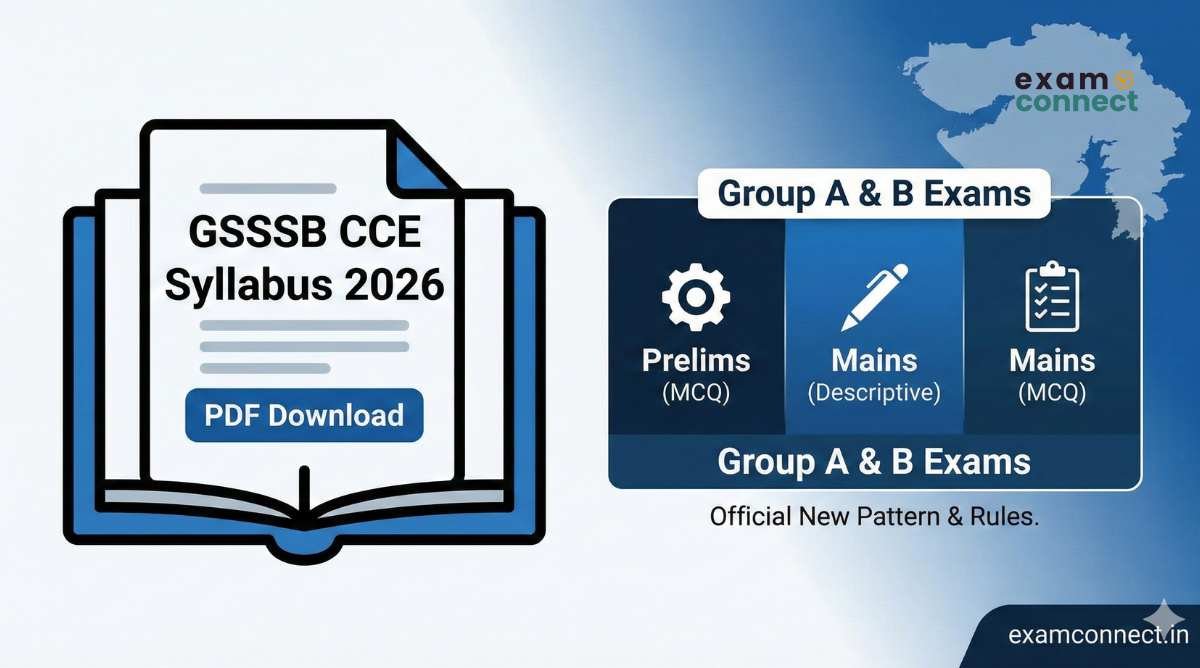
GSSSB CCE Syllabus 2026
The examination is divided into two successive stages: Preliminary and Main.
(Source: Gujarat Government Gazette Extra No. 4, Dated Jan 22, 2026)
1. Preliminary Examination (Common for Group A & B)
The Preliminary exam is a screening test. Marks obtained here are not counted for the final merit list.
CCE Exam Pattern – Preliminary Examination
(Common for all cadres)
- Reasoning: 60 Marks
- Quantitative Aptitude: 30 Marks
- General Awareness and Current Affairs: 30 Marks
- English: 15 Marks
- Gujarati: 15 Marks
| Detail | Specification |
| Type | Objective Type (MCQ) |
| Total Marks | 150 Marks |
| Duration | 2 Hours |
| Medium | Gujarati (English for English subject) |
| Negative Marking | 0.25 Marks |
Read More : GSSSB CCE Prelims Syllabus 2026 – Detailed
CCE Group A Mains Syllabus (Descriptive)
Qualifying candidates (approx. 7 times the vacancies) are called for the Mains.
Group A (Descriptive Type)
See Appendix H of the notification.
| Paper | Subject | Marks | Duration |
| Paper I | Gujarati Language Skill | 100 | 3 Hours |
| Paper II | English Language Skill | 100 | 3 Hours |
| Paper III | General Studies | 150 | 3 Hours |
| Total | 350 Marks |
CCE Group B Mains Syllabus (MCQ Type)
| Paper | Subject | Marks | Duration |
| Paper I | General Knowledge & Skills | 200 | 2 Hours |
See Appendix H of the notification.
Main Examination Syllabus (Group A – Descriptive)
Paper I: Gujarati Language (100 Marks)
- Essay Writing (approx. 250 words)
- Thought Expansion (Vichar Vistar)
- Precis Writing (Sankshepikaran)
- Prose Review (Gadya Samiksha)
- Preparing Statements for Media
- Letter Writing
- Discussion Paper (Charcha Patra)
- Report Writing
- Translation (English to Gujarati)
- Gujarati Grammar (Idioms, Proverbs, Sandhi, Alankar, etc.)
Paper II: English Language (100 Marks)
- Essay (approx. 250 words)
- Letter Writing (Formal)
- Report Writing
- Writing on Visual Information (Graph/Image/Table)
- Formal Speech
- Precis Writing
- Reading Comprehension
- English Grammar (Tenses, Voice, Narration, Articles, Prepositions, etc.)
- Translation (Gujarati to English)
Paper III: General Studies (150 Marks)
- History of India: Indus Valley, Maurya/Gupta empires, Gujarat dynasties, British rule, 1857 struggle, Mahatma Gandhi, Sardar Patel .
- Cultural Heritage: Indian culture, Arts/Crafts of Gujarat, Folk culture, Tribal culture .
- Geography: Physical features of Gujarat/India, Resources, Demographics, Disaster Management .
- Science and Technology: ICT, Space programs, Energy Policy, Defense technology .
- Events of Regional, National, and International Importance.
- Indian State System and Constitution: Features, Functions of Union/State, Federal structure .
- Public Administration and Governance: Civil services, E-Governance, RTI, Judiciary, Rights issues .
- Discipline in Public Service: Ethics, Attitude, Emotional Intelligence, Anti-corruption (Lokpal/Lokayukta) .
- Indian Economy and Planning: Planning, NITI Aayog, Public Finance, Gujarat Economy, Infrastructure .
Main Examination Syllabus (Group B – MCQ)
See Appendix G of the notification.
- Information on various Government Schemes: 30 Marks
- Regional, National and International Important Events (Current Affairs): 30 Marks
- Indian State System and Constitution: 20 Marks
- Indian Economy, State Economy, NITI Aayog: 20 Marks
- Public Administration and Governance: 20 Marks
- History and Geography of Gujarat: 20 Marks
- Science, Environment and Information Technology: 20 Marks
- Gujarati and English: 20 Marks
- Discipline and Ethics in Public Service: 10 Marks
- Cultural Heritage of Gujarat (Art and Literature): 10 Marks
Read Also : TAT Higher Secondary Syllabus 2025 & Exam Pattern
Marking Scheme & Weightage
- Prelims Negative Marking: Every incorrect answer carries a negative mark of 0.25. If an option is not selected, it also carries a -0.25 mark. To avoid this, candidates must select the “Not attempted” option.
- Mains (Group B) Negative Marking: Same as Prelims (-0.25 for wrong/blank answers).
- Mains (Group A – GS Paper): Contains questions ranging from 1 mark (10-20 words) to 5 marks (100 words).
Preparation Tips Based on Syllabus
- Prioritize Reasoning for Prelims: With 60 marks allocated to Reasoning in the Preliminary exam, this section has the highest weightage. High accuracy here is crucial for screening.
- Practice Descriptive Writing for Group A: If you are targeting Group A posts (Head Clerk, Office Assistant), daily practice of Essays, Reports, and Visual interpretation is essential as Papers I and II are purely descriptive.
- Focus on Gujarat-Specific Topics: Both Group A and B syllabi heavily feature Gujarat’s History, Geography, Economy, and Cultural Heritage.
- Master the “Not Attempted” Option: In MCQs, leaving a question blank penalizes you. You must select option (E) “Not attempted” to save the 0.25 mark deduction.
GSSSB CCE Post List
Based on the official notification provided in Appendix-A of the document, here is the complete list of posts categorized into Group-A and Group-B:
Group A Posts
(Positions listed in Appendix-A)
- Office Assistant, Class III (Secretariat Department)
- Office Assistant, Class III (Gujarat Public Service Commission)
- Senior Clerk, Class III (All State Government offices, except those in Appendix-B)
- Head Clerk, Class III (All State Government offices, except those in Appendix-B)
- Junior Clerk, Class III (Specifically in offices of the District Collector)
- Office Superintendent, Class III (Commissioner of Fisheries – Agriculture, Farmer Welfare and Co-operation Dept.)
- Office Superintendent, Class III (Director of Agriculture – Agriculture, Farmer Welfare and Co-operation Dept.)
- Office Superintendent, Class III (Director of Ayush – Health and Family Welfare Dept.)
- Office Superintendent, Class III (Commissioner of Cottage and Rural Industries – Industries and Mines Dept.)
- Junior Assistant, Class III (Director of Printing and Stationery – Industries and Mines Dept.)
- Deputy Chitnish (State Cadre), Class III (Panchayat, Rural Housing and Rural Development Dept.)
- Sub-Registrar Grade-1, Class III (Superintendent of Stamps and Inspector General of Registration – Revenue Dept.)
- Sub-Registrar Grade-2, Class III (Superintendent of Stamps and Inspector General of Registration – Revenue Dept.)
- Inspector of Stamps, Class III (Superintendent of Stamps and Inspector General of Registration – Revenue Dept.)
- Social Welfare Inspector, Class III (Director of Developing Castes Welfare – Social Justice and Empowerment Dept.)
- Assistant Social Welfare Officer, Class III (Director of Scheduled Caste Welfare – Social Justice and Empowerment Dept.)
- Social Welfare Inspector, Class III (Director of Scheduled Caste Welfare – Social Justice and Empowerment Dept.)
- House Holder, Class III (Director of Social Defense – Social Justice and Empowerment Dept.)
- Assistant Tribal Development Officer, Class III (Tribal Development Dept.)
- Assistant Social Welfare Officer, Class III (Director of Developing Castes Welfare – Social Justice and Empowerment Dept.)
- Assistant Superintendent, Class III (Narmada, Water Resources, Water Supply and Kalpsar Dept.)
- Office Superintendent (Commissioner of Geology & Mining – Industries and Mines Dept.)
- Office Superintendent (Office of Prison and Correction Administration – Home Dept.)
- Office Superintendent and Accountant (Directorate of Prohibition and Excise – Home Dept.)
- Prant Yuva Vikas Adhikari (Sports, Youth and Cultural Activities Dept.)
- Janasampark Adhikari (Commissioner of Transport – Port and Transport Dept.)
- Auditor Group-I (Commissionerate of Schools – Education Dept.)
Group B Posts
Positions listed in Appendix-A
- Junior Clerk, Class III
- In all State Government offices OTHER THAN the Office of District Collector.
- (Note: Junior Clerks in the Collector’s office are Group A; all others are Group B, excluding specific offices listed in Appendix B).
Summary & Next Steps
The GSSSB 2026 rules have standardized the syllabus for Class III recruitment. The clear distinction between Group A (Descriptive) and Group B (Objective) allows candidates to tailor their preparation strategies.
FAQs: CCE Syllabus 2026
What is the exam date for GSSSB CCE 2026 ?
The specific exam date is decided by the Board and will be notified in the advertisement.
Is there negative marking in the GSSSB CCE?
Yes, there is a negative marking of 0.25 for incorrect answers or leaving a question blank without selecting “Not attempted” in both Prelims and Group B Mains.
What is the syllabus for the CCE Group A Main Exam?
Group A Mains consists of three descriptive papers: Gujarati Language (100 marks), English Language (100 marks), and General Studies (150 marks).
Can I apply for both GSSSB CCE Group A and Group B?
Yes, a candidate can fill up the choice for Group A or Group B or both while applying for the Preliminary Examination.
Is the CCE Preliminary exam marks counted for final selection?
No, the Preliminary Examination is a screening test only. Final ranking is determined based on marks obtained in the Main Examination.

About Us
ExamConnect is your trusted source for the latest government job updates, exam notifications, admit cards, results, and career guidance.
Exam Category