
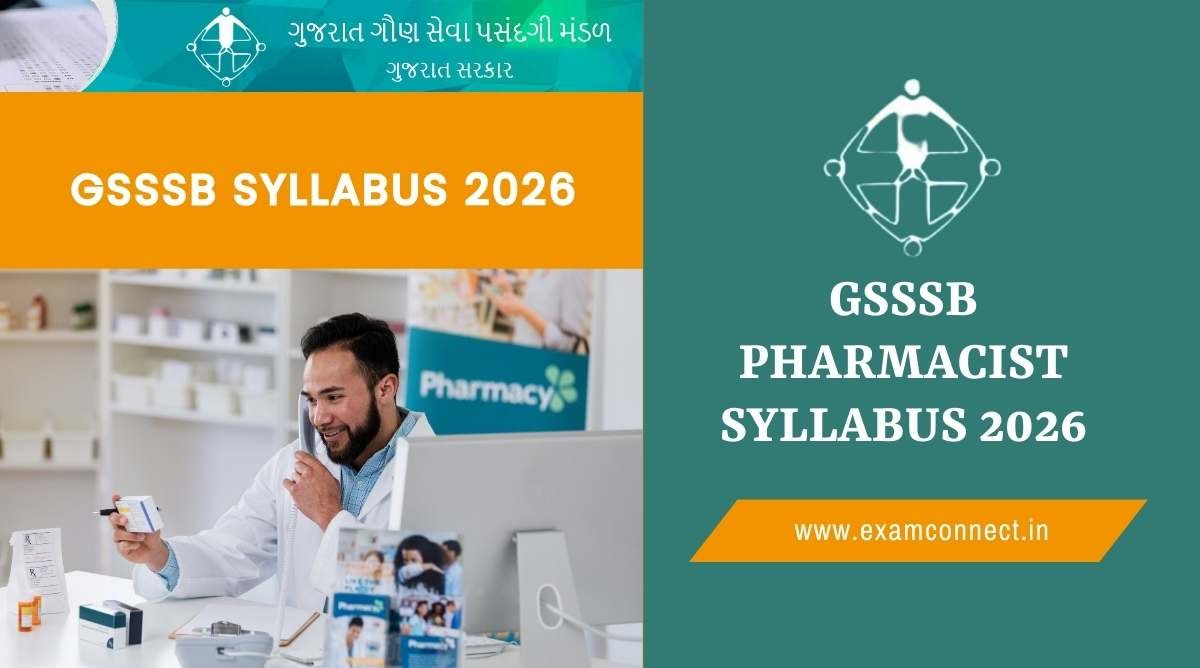
The GSSSB Pharmacist / Compounder (Ayurved) Class-3 recruitment exam is conducted through a competitive examination.
Candidates preparing for this recruitment must carefully review the official syllabus and exam pattern to understand the subjects and topics covered in the exam.
This article explains the official GSSSB Pharmacist Syllabus 2025, exam pattern, subject-wise syllabus, and marking scheme based strictly on the official notification.
Key Highlights : GSSSB Pharmacist Syllabus 2026
| Particular | Details |
| Exam Name | GSSSB Pharmacist / Compounder (Ayurved) Exam |
| Advertisement No. | 401/202526 |
| Post Name | Pharmacist / Compounder (Ayurved), Class-3 |
| Vacancies | As per official notification, details are awaited. |
| Exam Date | As per official notification, details are awaited. |
GSSSB Pharmacist Exam Pattern 2026
The exam consists of two parts.
| Part | Subject Area | Questions | Marks |
| Part-A | General Subjects | 90 | 90 |
| Part-B | Technical / Qualification Related Subjects | 120 | 120 |
| Total | — | 210 Questions | 210 Marks |
Part-A Subjects
| Subject | Questions | Marks |
| Reasoning & Data Interpretation | 30 | 30 |
| Quantitative Aptitude | 30 | 30 |
| Constitution of India | 10 | 10 |
| Current Affairs | 10 | 10 |
| Comprehension (Gujarati + English) | 10 | 10 |
| Total | 90 | 90 |
Part-B
| Section | Questions | Marks |
| Questions related to Technical Qualification | 120 | 120 |
Exam duration: As per official notification, details are awaited.
Negative marking: 1/4 mark deduction for each incorrect answer.
Read Also : GSSSB Staff Nurse (Ayurved) Syllabus 2025-26: Exam Pattern
Detailed Subject-wise Syllabus
Reasoning & Data Interpretation
- Problems on Ages
- Venn Diagram
- Visual Reasoning
- Blood Relation
- Arithmetic Reasoning
- Data Interpretation (Charts, Graphs, Tables)
- Data Sufficiency
Quantitative Aptitude
- Number Systems
- Simplification and Algebra
- Arithmetic and Geometric Progression
- Average
- Percentage
- Profit-Loss
- Ratio and Proportion
- Partnership
- Time and Work
- Time, Speed and Distance
- Work, Wages and Chain Rule
Constitution of India
- Preamble of the Constitution
- Fundamental Rights
- Directive Principles of State Policy
- Fundamental Duties
- Role and responsibilities of President, Vice President and Governor
- Parliamentary System
- Constitutional Amendments
- Emergency provisions
- Centre-State relations
- Judicial system of India
- Constitutional bodies
Current Affairs
- Current events of state, national and international importance
Comprehension
- Assessment of comprehension, interpretation and inference skills
- Paragraph-based questions
- Statement and assertion type questions
Part-B Technical Syllabus
Ayurveda Paricharya
- Definition of Ayu and its types (Hitayu, Ahitayu, Sukhayu, Dukhayu)
- Definition and objectives of Ayurveda
- Trisutra Ayurveda and Ashtanga of Ayurveda
- Ayurvedic traditions and classical texts
- Concept of Dosha, Dhatu and Mala
- Concepts related to life support systems and diseases
Swasthavritta
- Definition of health in Ayurveda and WHO
- Concept of Ahara and balanced diet
- Importance of Matrashana
- Nidra and its role in health
- Dincharya and daily health practices
- Concept of Desha and Kaal
- National health programmes and disaster management
Rachana Sharira
- Definition of Sharira
- Digestive system anatomy
- Cardiovascular system
- Respiratory system
- Urinary system
- Reproductive organs
- Nervous system
- Sense organs
Kriya Sharira
- Concept of Dosha and their functions
- Dhatu and their formation
- Mala and its functions
- Srotas and their vitiation
- Physiology of blood circulation and respiration
- Concept of Agni and digestion
Aushadh Nirman na Siddhant
- Dravya Guna concept
- Pharmacognosy and classification of drugs
- Pharmacology and drug actions
- Drug administration routes
- Drug regulations under Drugs & Cosmetic Act
Dravyaguna
- Classification of drugs according to Ayurvedic principles
- Classification based on rasa, vipaka, veerya and dosha karma
- Study of medicinal plants and drugs
- Knowledge of animal origin drugs
- Standardization of drugs
Rasashastra
- Definition and scope of Rasashastra
- Classification of Rasa, Maharasa, Uparasa and Dhatu
- Knowledge of yantras and putas
- Classification of Rasoushadhies
- Study of important Ayurvedic formulations
General Introduction of Treatment
- Concept of Nidan and diseases
- Types of chikitsa
- Examination of patient
- General knowledge of Rasayana and Vajikarana
- Knowledge of Shalya, Shalakya and Kaumarbhritya
Bhaishajya Kalpana
- Fundamental principles of Bhaishajya Kalpana
- Panchavidha Kashaya Kalpana
- Preparation methods of Ayurvedic medicines
- Concepts of shelf life and standardization
- Introduction to pharmacopoeia
Pharmacy Management
- Ayurvedic drug manufacturing unit
- GMP guidelines for Ayurvedic industries
- Documentation and SOPs
- Drug storage and quality control
- Hospital pharmacy services
- Drug distribution system in hospitals
- Drug information services
- Computer applications in pharmacy
Marking Scheme / Subject Weightage
| Section | Questions | Marks |
| Part-A | 90 | 90 |
| Part-B | 120 | 120 |
| Total | 210 | 210 |
Additional official instructions:
- 1/4 mark will be deducted for each incorrect answer.
- Questions will be available in Gujarati and English languages for Part-A.
Download GSSSB Pharmacist Syllabus PDF
Candidates can download the official syllabus released by GSSSB.
Download Official Syllabus PDF
(Source: Official Notification)
Summary & Next Steps
The GSSSB Pharmacist Syllabus 2025 consists of general aptitude subjects in Part-A and detailed Ayurveda and pharmacy-related technical subjects in Part-B.
Candidates should:
- Study the official syllabus topic-wise
- Solve previous year question papers
- Attempt mock tests based on the official exam pattern
FAQs: GSSSB Pharmacist Syllabus
What is the GSSSB Pharmacist Syllabus 2026?
The syllabus includes Reasoning, Quantitative Aptitude, Constitution of India, Current Affairs, Comprehension, and Ayurveda-related pharmacy subjects.
What is the exam pattern for GSSSB Pharmacist Exam 2026?
The exam consists of Part-A (90 marks) and Part-B (120 marks) with a total of 210 questions and 210 marks.
Is there negative marking in the GSSSB Pharmacist exam?
Yes. 1/4 mark is deducted for each wrong answer in the competitive exam.
Where can I download the GSSSB Pharmacist syllabus PDF?
Candidates can download the syllabus from the official GSSSB notification.
How should candidates prepare for the GSSSB Pharmacist exam?
Candidates should focus on Ayurveda and pharmacy subjects in Part-B, while also preparing reasoning, aptitude, and current affairs from Part-A.