
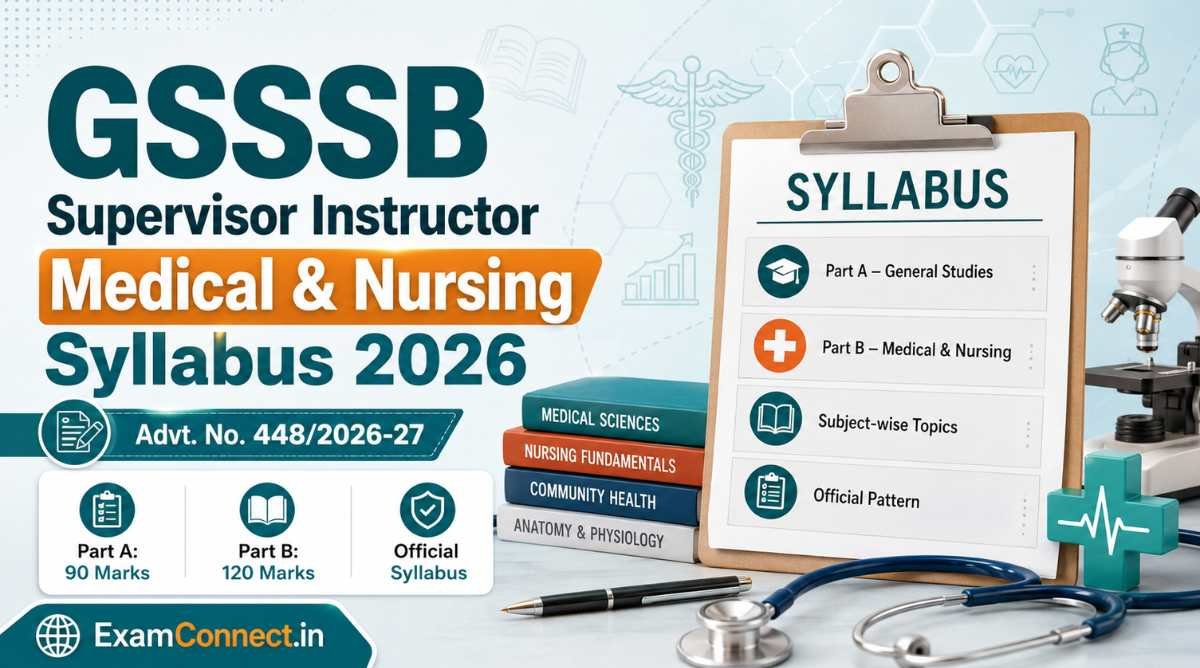
The GSSSB Supervisor Instructor Medical and Nursing Syllabus 2026 has been released for the Class 3 competitive examination under Advertisement No. 448/2026-27. The official syllabus includes a 90-mark Part A covering general subjects and a 120-mark Part B covering medical, nursing, public health, microbiology, biochemistry and radiography-related topics.
GSSSB Supervisor Instructor Medical and Nursing Exam Pattern 2026
The official syllabus is divided into Part A and Part B.
Part A carries 90 marks and focuses on general competitive-examination subjects. Part B carries 120 marks and contains questions related to the prescribed educational qualification and its applications.
| Exam-pattern component | Official details |
| Number of separate papers | As per official notification, details are awaited. |
| Examination structure | Part A and Part B |
| Part A questions | 90 questions |
| Part A marks | 90 marks |
| Part B questions | 120 questions |
| Part B marks | 120 marks |
| Total questions | 210 questions |
| Total marks | 210 marks |
| Exam duration | As per official notification, details are awaited. |
| Negative marking | One-fourth of the pro-rata marks assigned to an incorrectly answered question will be deducted. |
Part A Exam Pattern
| Subject | Questions | Marks |
| Reasoning and Data Interpretation | 30 | 30 |
| Quantitative Aptitude | 30 | 30 |
| Constitution of India | 10 | 10 |
| Current Affairs | 10 | 10 |
| Gujarati and English Comprehension | 10 | 10 |
| Total | 90 | 90 |
Gujarati Comprehension carries 5 marks, while English Comprehension carries 5 marks.
Part B Exam Pattern
| Subject | Questions | Marks |
| Questions related to the educational qualification and its applications | 120 | 120 |
Part B contains subjects associated with medical, nursing, public health, microbiology, biochemistry, radiography and related fields.
Language of the Examination
- Part A questions will be available in Gujarati and English.
- Constitution of India and Current Affairs questions will be available in Gujarati and English.
- Gujarati Comprehension questions will be asked only in Gujarati.
- English Comprehension questions will be asked only in English.
- Part B qualification-related questions will be available in Gujarati and English.
- The Gujarati syllabus translation is provided for candidates’ understanding.
- In case of a difference in interpretation, the English syllabus will be treated as final.
Detailed Subject-Wise Syllabus
Part A Syllabus
Reasoning and Data Interpretation
- Coding-Decoding
- Blood Relation
- Problems on Age and Height
- Direction Knowledge
- Clock and Calendar
- Venn Diagram
- Rank and Position
- Arithmetic Progression
- Logical Sequence of Words
- Insert the Missing Character
- Word Analogy
- Numerical Analogy
- General Analogy
- Picture-Based General Logical Questions
- Visual Reasoning
- Probability
- Data Interpretation using charts, graphs and tables
- Data Sufficiency
- Symmetry
- Mathematical Operations
- Mathematical Modelling
- Proofs in Mathematics
- Logical and Mathematical Analytical Ability
- Statement and Prediction
Quantitative Aptitude
- Number System
- LCM and HCF
- Percentage and Partnership
- Profit and Loss
- Simple Interest
- Compound Interest
- Ratio and Proportion
- Time and Work
- Wages
- Chain Rule
- Time, Speed and Distance
- Average
- Mean
- Mode
- Median
- Brackets and Expansions
- Square and Square Roots
- Cube and Cube Roots
- Exponents
- Polynomials and Factorisation
- Pair of Linear Equations in Two Variables
- Quadratic Equations
- Area, Surface Area and Volume
- Square
- Rectangle
- Triangle
- Circle
- Cube
- Cuboid
- Cylinder
- Cone
- Hemisphere
- Sphere
- Coordinate Geometry
- Trigonometry
Constitution of India
- Concept of Political Science
- Preamble of the Constitution
- Fundamental values of Democracy
- Nationalism and Secularism
- Rights and Citizenship
- Framing and Characteristics of the Indian Constitution
- Fundamental Rights
- Fundamental Duties
- Directive Principles of State Policy
- Legislature at Union and State levels
- Executive at Union and State levels
- Judiciary at Union and State levels
- Government at the local level
- Institutions of Local Self-Government
- Nature of the Party System in India
- Elections in India
- Indian Democracy: Challenges and Response
- Development and Democracy
Current Affairs
- Current events of state importance
- Current events of national importance
- Current events of international importance
Gujarati and English Comprehension
- Assessment of comprehension skills
- Assessment of interpretation skills
- Assessment of inference skills
- Questions based on a given paragraph
- Statement and assertion-type questions
- Gujarati Comprehension: 5 marks
- English Comprehension: 5 marks
Part B Medical and Nursing Syllabus
Anatomy and Physiology
- General and Applied Anatomy and Physiology
- Introduction to anatomical terms
- Organisation of the human body
- Respiratory system
- Digestive system
- Circulatory system
- Lymphatic system
- Endocrine system
- Sensory system
- Musculoskeletal system
- Skeletal system
- Muscular system
- Renal system
- Urinary system
- Reproductive system
- Nervous system
- Head and neck
- Spine and thorax
- Upper extremity
- Lower extremity
- General Physiology
- Blood
- All systems of the human body
Pathology
- General Pathology
- Haematology
- Blood Banking
- Histo-technology
- Cytology
- Museum Study
Disease Prevention and Control
- Control of Communicable Diseases
- Immunity
- Immunisation purpose, types and effects
- Care and treatment of patients with infection
- Disinfection
- Sterilisation
- Non-Communicable Diseases
- Basic Medicine
- Treatment of minor ailments
- First Aid
- Emergency Care
- Rehabilitation
- Health and Vital Statistics
- Health Management Information System
- Maintenance of records
- Reproductive Child Health
- Family Welfare
- Population Education
- Behavioural Science
- Communication Skills
- Infection Prevention and Control
- Counselling
Hygiene, Environmental Sanitation, Waste Management and Nutrition
Hygiene
- Personal Hygiene
- Physical Health
- Periodic Health Examination
- Health in the Home
- Mental Health and Hygiene
- Mental Hygiene and Health in Infancy
- Mental Hygiene and Health in Early Childhood
- Mental Hygiene and Health in Later Childhood
- Mental Hygiene and Health in Adolescence
- Mental Hygiene and Health in Adulthood
- Mental Hygiene and Health in Old Age
- Climate and Health
Environmental Sanitation and Waste Management
- Biomedical Waste Management
Nutrition and Nutrition Education
- Nutritive Value of Foodstuffs
- Balanced Diet
- Preparation and Preservation of Foods
- Cultural Factors in Nutrition
- Malnutrition
- Nutrition Education for Maternal and Child Health
Public Health Act
- Introduction to Public Health
- International Regulation of Health
- Public Health Act
- Public Health Problems in India
- Factors affecting the health of individuals
- Factors affecting family health
- Factors affecting community health
- National Health Programmes
- HIV/AIDS
- National Rural Health Mission
Ethics in Medical and Nursing Practice
- Ethical Principles in Healthcare
- Ethical Principles related to Medical Practice
- Ethical Principles related to Nursing Practice
- Scope of Practice
- Enforcing Standards in Health Professions
- Promoting Quality Care
- Professional Ethics in Research
- Professional Ethics in Education
- Professional Ethics in Patient-Care Delivery
- Informed Consent Issues
- Medical Ethics
- Economics in Clinical Decision-Making
Microbiology
- General Bacteriology
- Systematic Bacteriology
- Clinical Microbiology
- Mycology
- Immunology
- Serology
- Parasitology
- Virology
Microbial Nutrition and Introduction to Metabolism
- Modes of Nutritional Uptake
- Entry of Nutrients into the Cell
- Passive Diffusion
- Facilitated Diffusion
- Active Transport
- Classification of Bacteria according to Oxygen Requirements
- Classification according to Temperature
- Classification according to pH
- Classification according to Osmotic Pressure
- Classification according to Salt
- Classification according to Hydrostatic Pressure
- Introduction to Microbial Metabolism
- Anabolism
- Catabolism
- Primary Metabolism
- Secondary Metabolism
- Role of Reducing Power
- Precursor Metabolites
- Energy-Rich Compounds in Cell Metabolism
Biochemistry
- Glucose Homeostasis
- Overview of Diabetes Mellitus
- HGAIC
- Lipoprotein and Hyperlipoprotein
- Liver Function Test
- Renal Function Test
- Thyroid Function Test
- Alimentary Function Test
- Water and Electrolytic Balance
Basic Nursing and First Aid
- Basic Nursing and First Aid
- Child Health Nursing
- Mental Health Nursing
- Community Health Nursing
- Midwifery
- Obstetrics and Gynaecology Nursing
- Adult Health Nursing
- Pharmacology and Pathology
- Nursing Management and Leadership
- Professionalism
- Ethics and Professional Values
- Introduction to Forensic Nursing
- Indian Laws
- Applied Microbiology
- Infection Control
- Safety
- Applied Sociology
- Applied Psychology
- Nursing Foundations
- Applied Biochemistry
- Applied Nutrition and Dietetics
Medical Entomology
- Mosquitoes
- Sand Fly
- House Fly
- Tsetse Fly
- Bed Bug
- Louse
- Fleas
- Crustacea
Radiation Physics
- General Physics
- Radiation Physics
- Physics of Diagnostic Radiology
- Basic Concepts of Power
- Work
- Force
- Energy
- Electricity
- Magnetism
- Units and Measurements
- Einstein’s Formula
- Electromagnetic Induction
- Atomic Structure
- Radioactivity
- Ionisation
- Excitation
- Electromagnetic Waves
- X-ray Production and Properties
- X-ray Tube
- Quality of X-rays
- Factors Affecting the Quality of X-rays
- Factors Affecting the Intensity of X-rays
- X-ray Circuits
- Interaction of X-rays and Gamma Rays
- X-radiation Measurements
- Principles of Radiation Detection and Measurement
- TLD
- Pocket Dosimeter
- Radiation Survey Meter
- Radiation Zone Monitor
Clinical Radiography
- Facial Bones and Sinuses
- Abdomen and Pelvic Cavity
- Ward Radiography
- Theatre Radiography
- Paediatric Radiography
- Mammography
- Foreign-Body Localisation
- Forensic Radiology
- Soft-Tissue Radiology
- Contrast and Special Radiography Procedures
- Barium Swallow
- Barium Meal
- Barium Enema
- Single-Contrast Barium Enema
- Double-Contrast Barium Enema
- Enteroclysis
- Percutaneous Transhepatic Biliary Drainage
- Sinograms
- Fistulograms
- Advanced Radiology
- IVU
- IVP
- MCU
- RGU
- HSG
- Sialogram
- T-tube
- Cholangiography
- Fluoroscopy
- Image Intensifiers
- Tomography Basics
Current Trends and Recent Advancements
- Current trends and recent advancements in the medical, nursing and related fields listed in the official syllabus
- A separate question or mark allocation is not specified for this topic.
Marking Scheme and Subject Weightage
Part A Weightage
| Subject | Questions | Marks |
| Reasoning and Data Interpretation | 30 | 30 |
| Quantitative Aptitude | 30 | 30 |
| Constitution of India | 10 | 10 |
| Current Affairs | 10 | 10 |
| Gujarati Comprehension | Included within 10 comprehension questions | 5 |
| English Comprehension | Included within 10 comprehension questions | 5 |
| Total | 90 | 90 |
Part B Subject Weightage
| Medical and Nursing subject | Questions | Marks |
| Anatomy and Physiology | 20 | 20 |
| Pathology | 10 | 10 |
| Disease Prevention and Control | 15 | 15 |
| Hygiene, Environmental Sanitation, Waste Management and Nutrition | 10 | 10 |
| Public Health Act | 10 | 10 |
| Ethics in Medical and Nursing Practice | 5 | 5 |
| Microbiology | 5 | 5 |
| Microbial Nutrition and Introduction to Metabolism | 5 | 5 |
| Biochemistry | 10 | 10 |
| Basic Nursing and First Aid | 15 | 15 |
| Medical Entomology | 5 | 5 |
| Radiation Physics | 5 | 5 |
| Clinical Radiography | 5 | 5 |
| Current Trends and Recent Advancements | No separate allocation specified | No separate allocation specified |
| Total | 120 | 120 |
The marks shown against individual Part B topics are indicative marks provided for candidates’ information. The Board may make general changes when necessary.
Negative Marking
- Correct answers will receive marks according to the pro-rata weight assigned to the question.
- For an incorrect answer, one-fourth of the pro-rata marks assigned to that question will be deducted.
- If a question is cancelled while publishing the final answer key, its marks will be calculated among the remaining questions according to the pro-rata method.
Preparation Tips Based on the Syllabus
Give More Study Time to Part B
Part B carries 120 marks, while Part A carries 90 marks. Candidates should reserve a larger portion of their study schedule for medical and nursing subjects without ignoring Part A.
Prioritise High-Weightage Medical Subjects
Anatomy and Physiology carries the highest individual weightage of 20 marks.
The following subjects carry 15 marks each:
- Disease Prevention and Control
- Basic Nursing and First Aid
Candidates should complete these high-weightage areas early and revise them regularly.
Build a Balanced Part A Schedule
Reasoning and Data Interpretation and Quantitative Aptitude carry 30 marks each. Together, these two sections account for 60 of the 90 Part A marks.
Candidates should practise both sections regularly instead of focusing on only one.
Study Related Subjects Together
Certain Part B topics can be organised into connected study groups:
- Anatomy, Physiology and Pathology
- Microbiology, Microbial Nutrition and Infection Control
- Public Health, Disease Prevention and Hygiene
- Basic Nursing, First Aid and Medical Ethics
- Radiation Physics and Clinical Radiography
This approach can help candidates revise related official topics systematically.
Prepare Comprehension in the Prescribed Language
Gujarati Comprehension will be asked only in Gujarati, while English Comprehension will be asked only in English. Each language section carries 5 marks.
Consider Negative Marking During Practice
As one-fourth of the assigned pro-rata marks will be deducted for an incorrect answer, candidates should practise accuracy along with speed.
Do Not Assume the Exam Duration
The examination duration is not specified in the uploaded syllabus. Candidates should wait for the official examination programme before preparing a final time-per-question strategy.
Download GSSSB Supervisor Instructor Medical and Nursing Syllabus PDF
The detailed syllabus has been released for the Supervisor Instructor, Medical and Nursing Group, Class 3 competitive examination under Advertisement No. 448/2026-27.
Download Official Syllabus PDF
Source: Official detailed syllabus issued by the Gujarat Subordinate Service Selection Board.
A separate official syllabus download URL was not included in the provided input. As per official notification, details are awaited.
Summary and Next Steps
The GSSSB Supervisor Instructor Medical and Nursing Syllabus 2026 contains a total syllabus allocation of 210 marks.
Part A carries 90 marks and includes general competitive subjects. Part B carries 120 marks and includes medical, nursing, public-health, laboratory and radiography-related topics.
Candidates should take the following next steps:
- Prepare a study plan according to the 90-mark and 120-mark division.
- Begin Part B with Anatomy and Physiology, Disease Prevention and Control, and Basic Nursing and First Aid.
- Practise Reasoning and Quantitative Aptitude regularly.
- Use mock tests that follow the official subject and marks distribution.
- Match previous-year questions with the topics listed in the current official syllabus.
- Revise medical terminology, health programmes, diagnostic topics and nursing concepts subject-wise.
- Check the Board’s website for the examination date and call-letter schedule.
FAQs : GSSSB Supervisor Instructor Medical and Nursing Syllabus 2026
What is the latest GSSSB Supervisor Instructor Medical and Nursing Syllabus 2026?
The latest provided syllabus is for the Supervisor Instructor, Medical and Nursing Group, Class 3 examination under Advertisement No. 448/2026-27. It includes a 90-mark Part A and a 120-mark Part B.
What is the GSSSB Supervisor Instructor Medical and Nursing exam pattern?
The official syllabus specifies 90 questions for 90 marks in Part A and 120 questions for 120 marks in Part B. The total syllabus distribution is 210 questions and 210 marks.
Is there negative marking in the GSSSB Supervisor Instructor exam?
Yes. One-fourth of the pro-rata marks assigned to an incorrectly answered question will be deducted from the candidate’s score.
Where can I download the GSSSB Supervisor Instructor Medical syllabus PDF?
Candidates can download the official syllabus PDF provided with the article. A separate external official download URL was not included in the available inputs.
How should I prepare for the GSSSB Supervisor Instructor Medical and Nursing exam?
Candidates should prioritise Part B because it carries 120 marks. Anatomy and Physiology should receive the highest individual priority, followed by Disease Prevention and Control and Basic Nursing and First Aid. Part A Reasoning and Quantitative Aptitude should also be practised regularly.