
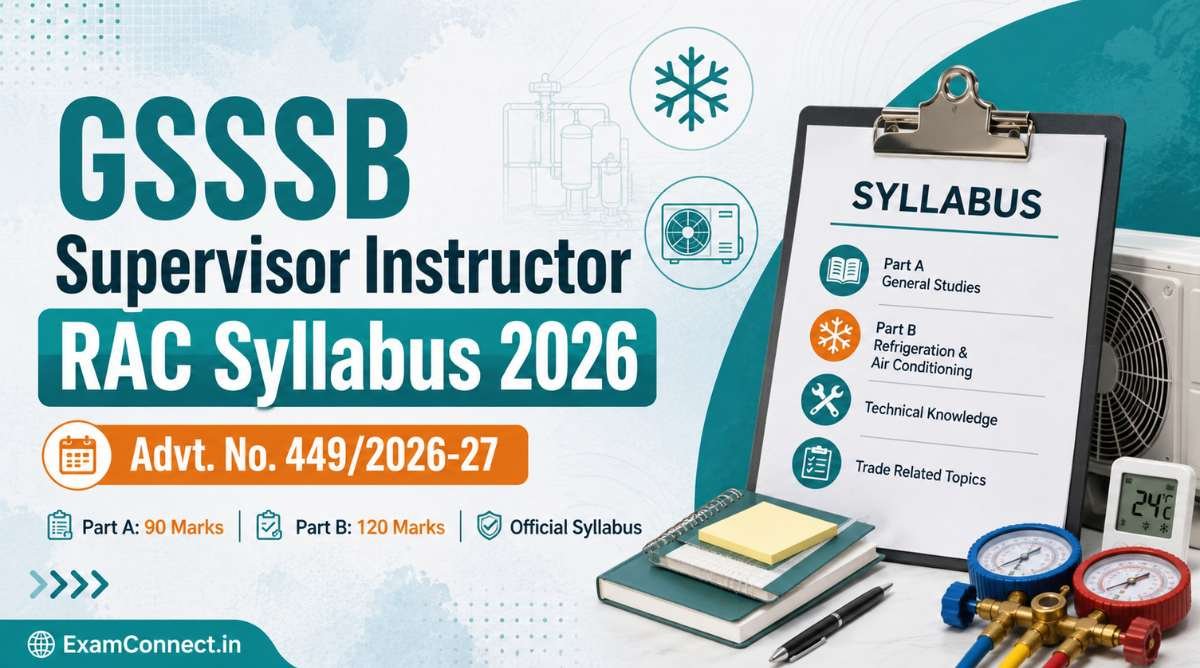
GSSSB Supervisor Instructor RAC Syllabus 2026: Check exam pattern, subject-wise syllabus, marks, negative marking and official PDF details.
- The syllabus is for the Supervisor Instructor (Refrigeration and Air Conditioning Group), Class 3 competitive examination under Advertisement No. 449/2026-27.
- The examination syllabus is divided into Part A for 90 marks and Part B for 120 marks.
- Part A covers Reasoning, Quantitative Aptitude, Constitution of India, Current Affairs and Gujarati-English Comprehension.
- Part B contains questions related to the prescribed educational qualification and its applications in refrigeration and air conditioning.
- Candidates can use the official syllabus PDF to plan subject priorities, practise according to the marking scheme and avoid studying topics outside the notified syllabus.
GSSSB Supervisor Instructor Exam Pattern 2026
The official syllabus divides the examination into Part A and Part B. Part A carries 90 marks, while Part B carries 120 marks.
| Exam-pattern component | Official details |
| Number of separate papers | As per official notification, details are awaited. |
| Examination structure | Part A and Part B |
| Part A questions | 90 questions |
| Part A marks | 90 marks |
| Part B questions | 120 questions |
| Part B marks | 120 marks |
| Total questions across both parts | 210 questions |
| Total marks across both parts | 210 marks |
| Exam duration | As per official notification, details are awaited. |
| Negative marking | One-fourth of the pro-rata marks assigned to a question will be deducted for an incorrect answer. |
Part A Exam Pattern
| Subject | Questions | Marks |
| Reasoning and Data Interpretation | 30 | 30 |
| Quantitative Aptitude | 30 | 30 |
| Constitution of India | 10 | 10 |
| Current Affairs | 10 | 10 |
| Gujarati and English Comprehension | 10 | 10 |
| Total | 90 | 90 |
Gujarati Comprehension carries 5 marks and English Comprehension carries 5 marks.
Part B Exam Pattern
| Subject | Questions | Marks |
| Questions related to the educational qualification and its applications | 120 | 120 |
Part B covers refrigeration and air-conditioning subjects associated with the prescribed educational qualification.
Language of Questions
- Part A questions will be available in Gujarati and English.
- Constitution of India and Current Affairs questions will be available in Gujarati and English.
- Gujarati Comprehension questions will be available only in Gujarati.
- English Comprehension questions will be available only in English.
- Part B technical questions will be available in Gujarati and English.
- Where interpretation of the Gujarati translation differs, the English syllabus will be treated as final.
Also Read: GPSSB Laboratory Technician Syllabus 2026
GSSSB Supervisor Instructor RAC Syllabus 2026
Part A Syllabus
Reasoning and Data Interpretation
- Coding-Decoding
- Blood Relation
- Problem on Age and Height
- Direction Knowledge
- Clock and Calendar
- Venn Diagram
- Rank and Position
- Arithmetic Progression
- Logical Sequence of Words
- Insert the Missing Character
- Word, Numerical and General Analogy
- Picture-Based General Logical Questions or Visual Reasoning
- Probability
- Data Interpretation using charts, graphs and tables
- Data Sufficiency
- Symmetry
- Mathematical Operations
- Mathematical Modelling
- Proofs in Mathematics
- Logical and Mathematical Analytical Ability
- Statement and Prediction
Quantitative Aptitude
- Number System
- LCM and HCF
- Percentage and Partnership
- Profit and Loss
- Simple and Compound Interest
- Ratio and Proportion
- Time and Work
- Wages and Chain Rule
- Time, Speed and Distance
- Average, Mean, Mode and Median
- Brackets and Expansions
- Square and Square Roots
- Cube and Cube Roots
- Exponents
- Polynomials and Factorisation
- Pair of Linear Equations in Two Variables
- Quadratic Equations
- Area, Surface Area and Volume of Square, Rectangle, Triangle, Circle, Cube, Cuboid, Cylinder, Cone, Hemisphere and Sphere
- Coordinate Geometry
- Trigonometry
Constitution of India
- Concept of Political Science
- Preamble of the Constitution
- Fundamental values of Democracy
- Nationalism and Secularism
- Rights and Citizenship
- Framing and Characteristics of the Indian Constitution
- Fundamental Rights
- Fundamental Duties
- Directive Principles of State Policy
- Legislature, Executive and Judiciary in India at Union and State levels
- Government at the local level
- Institutions of Local Self-Government
- Nature of the Party System in India
- Elections in India
- Indian Democracy: Challenges and Response
- Development and Democracy
Current Affairs
- Current events of state importance
- Current events of national importance
- Current events of international importance
Gujarati and English Comprehension
- Assessment of comprehension skills
- Assessment of interpretation skills
- Assessment of inference skills
- Questions based on a given paragraph
- Statement and assertion-type questions
- Gujarati Comprehension: 5 marks
- English Comprehension: 5 marks
Part B Technical Syllabus
Introduction of Refrigeration
- Refrigeration
- Heat load
- Need for thermal insulation
- Refrigerating agent
- Development of refrigeration
- Unit of refrigeration
- Heat pump
- Refrigeration tools
- Basic refrigeration practice
Refrigerants
- Introduction
- Development of refrigerants
- Classification of refrigerants
- Designation and numbering of refrigerants
- Requirements for selection of refrigerants
- Safety procedure
- Common refrigerants
- New refrigerants
- Secondary refrigerants
- Future industrial refrigerants
- Role of specific heat in the selection of refrigerant
Vapour Compression System
- Mechanical refrigeration
- Chemical agent refrigeration system
- Temperature-entropy diagram and its reading
- Wet compression
- Dry compression
- Pressure-enthalpy diagram
- Reading the pressure-enthalpy chart
- Standard rating cycle
- Coefficient of Performance, or COP
- Energy Efficiency Ratio, or EER
- Heat of compression
- Work of compression
- Heat of rejection
- Factors affecting the performance of a vapour compression system
- Comparison of the theoretical vapour compression cycle with the Carnot cycle
- Departure from the theoretical vapour compression cycle
Absorption System
- Introduction
- Development
- Basic terminology
- Benefits of absorption systems
- Refrigerant-absorber pairs
- Required system characteristics
- Matching heat sources
- Cooling loads and heat sinks
- Heat recovery
- Desirable properties of absorption-system refrigerant and absorber
- Simple ammonia absorption system
- Solution concentration levels
- Practical aqua-ammonia system
- Influence of solvent and solvent-refrigerant combination
- Analysis of aqua-ammonia refrigeration system
- Comparison of vapour compression and vapour absorption systems
- Lithium bromide absorption system
Components of Refrigeration System
- Refrigeration compressors
- Types of compressors
- Applications of various compressors
- Classification of refrigeration compressors according to the arrangement of the motor
- Electric motor for hermetic compressor
- Starting capacitor
- Running capacitor
- Compressor controls
- Minimum compression work
- Indicator diagram
- Compressor efficiency and COP
- Compressor performance
- Subcooling
- Heat rejection
- Condensers
- Functions and purposes of condensers
- Operation and types of condensers
- Condenser load
- Heat rejection factor or heat rejection ratio
- Condenser capacity
- Receiver
- Expansion device
- Types of expansion devices
- Evaporators
- Operation and types of evaporators
- Evaporator capacity
- Effect of air quantity on evaporator capacity
- Performance and ratings
Psychrometry and Psychrometric Chart
- Properties of air
- Water vapour in the air
- Relationship between atmospheric air pressure and water-vapour pressure
- Moisture content of air
- Humidity
- Temperatures
- Dew point
- Wet-bulb depression
- Enthalpy of moist air
- Adiabatic saturation of air
- Relationship between humidity ratio and dry-bulb and wet-bulb temperatures
- Specific volume of moist air
- Specific heat of moist air
- Thermodynamic wet-bulb temperature
- Adiabatic saturation temperature
- Humidity-measuring instruments
- Psychrometric chart
- Plotting of the psychrometric chart
- Psychrometric processes
- Sensible heating and cooling
- Heating with humidification
- Cooling with dehumidification
- Constant relative-humidity process
- Adiabatic cooling
- Cooling with constant enthalpy
- Evaporative cooling
- Adiabatic chemical dehumidification
- Contact factor
- Bypass factor, or BF/BPF
Residential and Commercial Refrigeration
- Definition
- Primary function
- Secondary function
- Preservation of food by refrigeration
- Optimum conditions for fresh-food preservation
- Advantages of refrigerated and frozen food
- Working cycles
- Design trends affecting component selection
- Advantages of a sealed unit over an open unit
- Types of refrigerators
- Refrigerator cabinet
- Domestic refrigerator construction
- Defrosting in a domestic refrigerator
- Refrigerant overcharge and shortage in a system
- Load analysis of a domestic refrigerator
- Requirements of commercial refrigeration equipment
- Construction of commercial cabinets
- Types of commercial cabinets
- Cabinet construction
- Simple systems compared with combined systems
- Water cooler
- Bottle cooler
- Cooling tower
- Car air conditioning
- Maintenance and servicing of refrigeration equipment
- Energy-efficiency and optimisation techniques
- Troubleshooting common refrigeration-system issues
Refrigeration Piping, Accessories and Control
- Introduction
- Basic principles of piping systems
- Functions of the piping system
- Application considerations
- Code requirements
- Piping materials
- Design considerations
- Service limitations
- Expansion of piping
- Supports and anchors
- Vibration isolation
- Insulation of refrigerant pipelines
- Pipe joints and fittings
- Refrigerant-line velocities
- Pressure-drop considerations
- Line capacities
- Water piping
- Design procedure for water piping
- Piping layout
- Refrigeration accessories
- Refrigeration valves
Commissioning and Refrigeration Plant
- Sources of moisture
- Effects of moisture
- Drying methods
- Desiccants
- Driers
- Dehydration
- Evacuation
- Checking for leakage
- Plant commissioning
- Testing of the system during commissioning
Air and Human Comfort
- Air temperature and human health
- Body thermoregulation
- Body-temperature regulation
- Steady-state energy balance
- Environmental influences on comfort
- Ventilation requirements
- Effective temperature
- Comfort chart
- Factors affecting or governing effective temperature
Current Trends and Recent Advancements
- Current trends and recent advancements in the above refrigeration and air-conditioning fields
- A separate question or mark allocation is not specified for this topic in the official syllabus.
Marking Scheme and Subject Weightage
Part A Subject Weightage
| Subject | Questions | Marks |
| Reasoning and Data Interpretation | 30 | 30 |
| Quantitative Aptitude | 30 | 30 |
| Constitution of India | 10 | 10 |
| Current Affairs | 10 | 10 |
| Gujarati Comprehension | Included within 10 comprehension questions | 5 |
| English Comprehension | Included within 10 comprehension questions | 5 |
| Total | 90 | 90 |
Part B Technical Subject Weightage
| Technical unit | Questions | Marks |
| Introduction of Refrigeration | 10 | 10 |
| Refrigerants | 15 | 15 |
| Vapour Compression System | 15 | 15 |
| Absorption System | 10 | 10 |
| Components of Refrigeration System | 15 | 15 |
| Psychrometry and Psychrometric Chart | 15 | 15 |
| Residential and Commercial Refrigeration | 15 | 15 |
| Refrigeration Piping, Accessories and Control | 5 | 5 |
| Commissioning and Refrigeration Plant | 10 | 10 |
| Air and Human Comfort | 10 | 10 |
| Current Trends and Recent Advancements | No separate allocation specified | No separate allocation specified |
| Total Part B allocation | 120 | 120 |
The marks shown against the technical topics are described by the Board as indicative marks for candidates’ information. The Board may make general changes where required.
Negative Marking
- Marks will be awarded according to the pro-rata weight assigned to each correctly answered question.
- For an incorrect answer, one-fourth of the pro-rata marks assigned to that question will be deducted.
- When a question is cancelled after publication of the provisional answer key, its marks will be distributed among the remaining questions according to the pro-rata method.
Preparation Tips Based on the Official Syllabus
Prioritise Part B Technical Subjects
Part B carries 120 marks, compared with 90 marks for Part A. Candidates should therefore provide sufficient preparation time to the refrigeration and air-conditioning subjects while continuing regular Part A practice.
Complete the 15-Mark Technical Units First
The following units carry 15 marks each:
- Refrigerants
- Vapour Compression System
- Components of Refrigeration System
- Psychrometry and Psychrometric Chart
- Residential and Commercial Refrigeration
These five units together account for a substantial portion of Part B.
Balance Reasoning and Quantitative Aptitude
Reasoning and Data Interpretation and Quantitative Aptitude carry 30 marks each. Candidates should give both subjects equal importance instead of concentrating on only one section.
Prepare Comprehension in the Correct Language
Gujarati Comprehension must be prepared in Gujarati, while English Comprehension must be prepared in English. Each language section carries 5 marks.
Use the Negative-Marking Rule Carefully
Because an incorrect response attracts a deduction of one-fourth of the assigned marks, candidates should avoid selecting answers without adequately checking them.
Do Not Assume an Exam Duration
The examination duration has not been specified in the provided official syllabus. Candidates should not finalise a time-per-question strategy until the official duration is announced.
Follow the English Version in Case of Interpretation Differences
The Gujarati translation is provided for candidates’ understanding. In case of any difference in interpretation, the English syllabus will be considered final.
10. Download GSSSB Supervisor Instructor Syllabus PDF
The detailed syllabus has been issued for the Supervisor Instructor, Refrigeration and Air Conditioning Group, Class 3 examination under Advertisement No. 449/2026-27.
Source: Official detailed syllabus issued by the Gujarat Subordinate Service Selection Board.
A separate external official syllabus webpage or download URL was not included in the provided inputs. As per official notification, details are awaited.
Summary and Next Steps
The GSSSB Supervisor Instructor RAC Syllabus 2026 contains two parts carrying a combined total of 210 marks. Part A covers general competitive-examination subjects, while Part B focuses on refrigeration and air-conditioning topics connected with the educational qualification.
Candidates should take the following next steps:
- Create a study plan based on the official 90-mark and 120-mark division.
- Allocate more revision sessions to the five technical units carrying 15 marks each.
- Practise Part A questions according to the notified subject distribution.
- Match every mock-test section with the latest official syllabus.
- Check previous-year questions only after confirming that their topics are included in the current syllabus.
- Follow the Board’s website for the examination date and call-letter schedule.
FAQs: GSSSB Supervisor Instructor RAC Syllabus 2026
What is the latest GSSSB Supervisor Instructor RAC Syllabus 2026?
The latest provided syllabus is for the Supervisor Instructor, Refrigeration and Air Conditioning Group, Class 3 competitive examination under Advertisement No. 449/2026-27. It includes Part A general subjects and Part B technical subjects.
What is the GSSSB Supervisor Instructor exam pattern?
The official syllabus specifies Part A for 90 questions and 90 marks and Part B for 120 questions and 120 marks. The combined syllabus therefore covers 210 questions and 210 marks. The number of separate papers and examination duration have not been specified.
Is there negative marking in the GSSSB Supervisor Instructor exam?
Yes. For an incorrect answer, one-fourth of the pro-rata marks assigned to that question will be deducted from the candidate’s score.
Where can I download the GSSSB Supervisor Instructor syllabus PDF?
Candidates can download the attached official syllabus PDF from the “Download GSSSB Supervisor Instructor Syllabus PDF” section of this article. A separate external official download URL was not provided in the available inputs.
How should I prepare according to the GSSSB Supervisor Instructor Refrigeration syllabus?
Candidates should first divide preparation between the 90-mark Part A and the 120-mark Part B. Within Part B, priority should be given to Refrigerants, Vapour Compression System, Refrigeration System Components, Psychrometry and Residential and Commercial Refrigeration because each unit carries 15 marks.